
Aeronero vs RO vs Bottled Water: Which Is Better for Your Health, Your Wallet and the Planet?
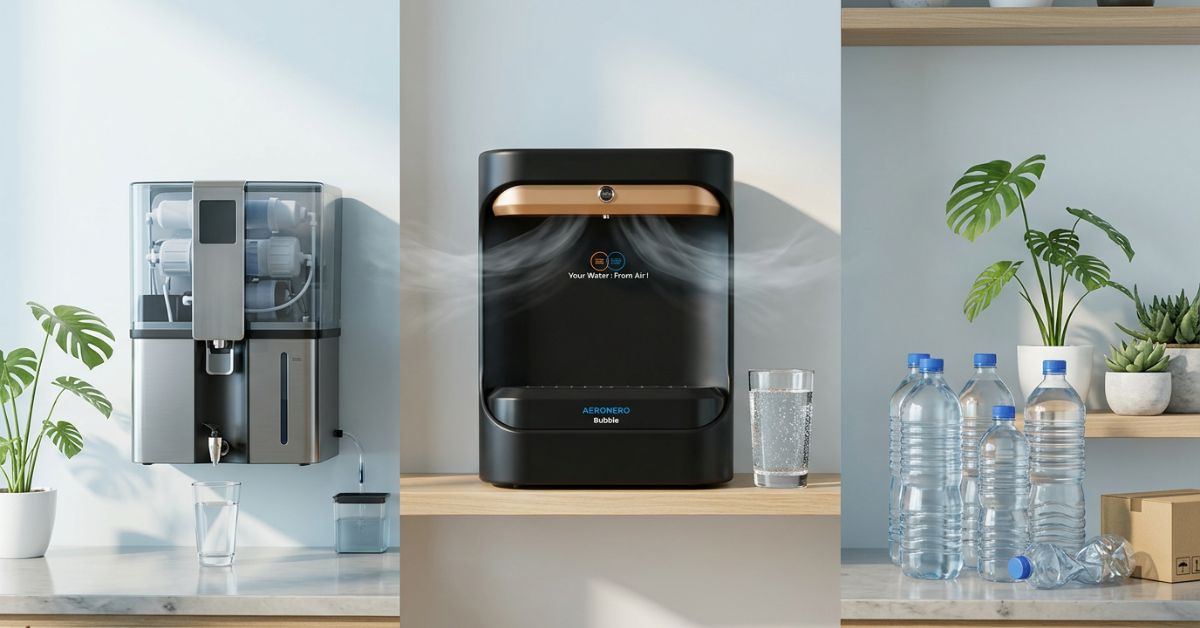
Every Indian household and business faces the same daily question: where should our drinking water come from? For years the answer has been one of two options. You install an RO purifier, or you order bottled water. Both are familiar and both work to a degree, but both come with costs that many people never see on the bill.
A third option is now available: water made directly from the air. In this post we compare Aeronero's atmospheric water generators (AWG) with RO water and bottled water on three things that matter most: your health, your wallet and the planet.
The Problem With How We Get Water Today
By 2050, more than 60% of the global population is expected to face water stress. Groundwater is already being drawn down faster than it can recover in many regions, and both of the most common drinking-water solutions depend on that same stressed supply.
RO purifiers need a source, usually municipal or borewell water. Bottled water plants draw from groundwater or treated sources, then add plastic, transport and storage. Neither option reduces pressure on the resource everyone is running short of.
Round 1: Health
RO water. RO systems force water through a membrane that removes dissolved salts and many contaminants. That is useful when the input water is very hard or contaminated. The drawback is that RO also strips out beneficial minerals like calcium and magnesium unless the unit has a remineralisation stage. The output is also only as good as the source water and the maintenance of the membrane and filters.
Bottled water. Bottled water is convenient, but its quality depends on every step between the plant and your glass: bottling, transport, storage, handling and how long the bottle has been sitting. Plastic bottles also raise concerns about microplastics and chemical leaching, especially when stored in heat. Your site's own comparison notes that bottled water carries risks from bottling through to storage, and that microbes can spread through human handling.
Aeronero water. Aeronero's process starts with air rather than ground or tap water. The moisture is condensed, then passed through a six-stage process: air filtration, cooling and condensation, pre-carbon filtration, post-carbon filtration, ultra UV purification and mineralisation. The final step adds essential minerals and keeps the water at an alkaline pH of 7.0–8.5. Because the water is made and dispensed at the point of use, there are fewer handling stages where contamination can creep in.
Winner on health: Aeronero, thanks to its mineral balance, UV sterilisation and minimal handling.
Round 2: Your Wallet
Price per litre is where many buyers assume atmospheric water must lose. It doesn't.
According to Aeronero's comparison, the cost per litre works out to about:
- Aeronero: Rs. 3.5
- RO water: Rs. 4
- Bottled water: Rs. 4
The gap looks small per litre, but it adds up. A household drinking 20 litres a day, or an office serving a team, will see a meaningful saving over a year. And the comparison doesn't include the hidden costs of the alternatives:
- RO: membrane and filter replacements, service visits, and the water you lose to reject flow.
- Bottled water: delivery charges, storage space, deposits and the time spent managing orders.
Aeronero's systems also don't depend on tankers, taps or borewells. For buildings that regularly pay for tanker water in summer, that independence has a real financial value.
Winner on cost: Aeronero, with the lowest cost per litre and fewer dependencies.
Round 3: The Planet
This is where the difference is largest.
Water wastage. Conventional RO systems are known for wasting water. Aeronero's comparison puts RO wastage at more than 50%, meaning for every litre you drink, more than a litre may go down the drain. Bottled water production also carries a significant water footprint. Aeronero's process, by contrast, produces water without depleting groundwater and has no reject stream.
Plastic pollution. Bottled water generates a steady stream of single-use and multi-use plastic. RO systems come with plastic housings and cartridges. Aeronero's comparison lists plastic pollution as nil for its systems, because water is dispensed directly rather than packaged.
Carbon footprint. Bottled water has to be transported, often over long distances, which raises its carbon footprint. RO has an energy cost too. Aeronero rates its own footprint as low, since it removes the transport step and works without drawing from the ground.
Groundwater. RO and bottled water both lean on groundwater or municipal supply. An AWG works with the moisture already in the air and gives back to the water cycle instead of drawing from it.
Winner on the planet: Aeronero, by a wide margin.
Is an Atmospheric Water Generator Right for You?
An AWG suits homes, offices, hotels, hospitals, schools, industrial sites and remote locations. Aeronero's range starts with Bubble, which makes up to 20 litres a day for homes and small offices, and scales up to Airwell, which makes 500 litres a day for industrial use. If you would like a subscription instead of buying a machine, the Aquair water-as-a-service model delivers premium alkaline water without the hardware.
Actual output depends on the local temperature and humidity, so it's wise to book a demo and size the system to your location and usage.
The Bottom Line
RO and bottled water solved yesterday's problem. They deliver drinkable water, but they do it in ways that add plastic, waste and pressure on a shrinking groundwater supply. Aeronero's approach delivers mineral-rich, UV-purified alkaline water at a lower cost per litre and with a much smaller environmental footprint.
Ready to see the difference? Schedule a demo with Aeronero and find the system that fits your home or business.