
Can You Really Make Drinking Water from Air?
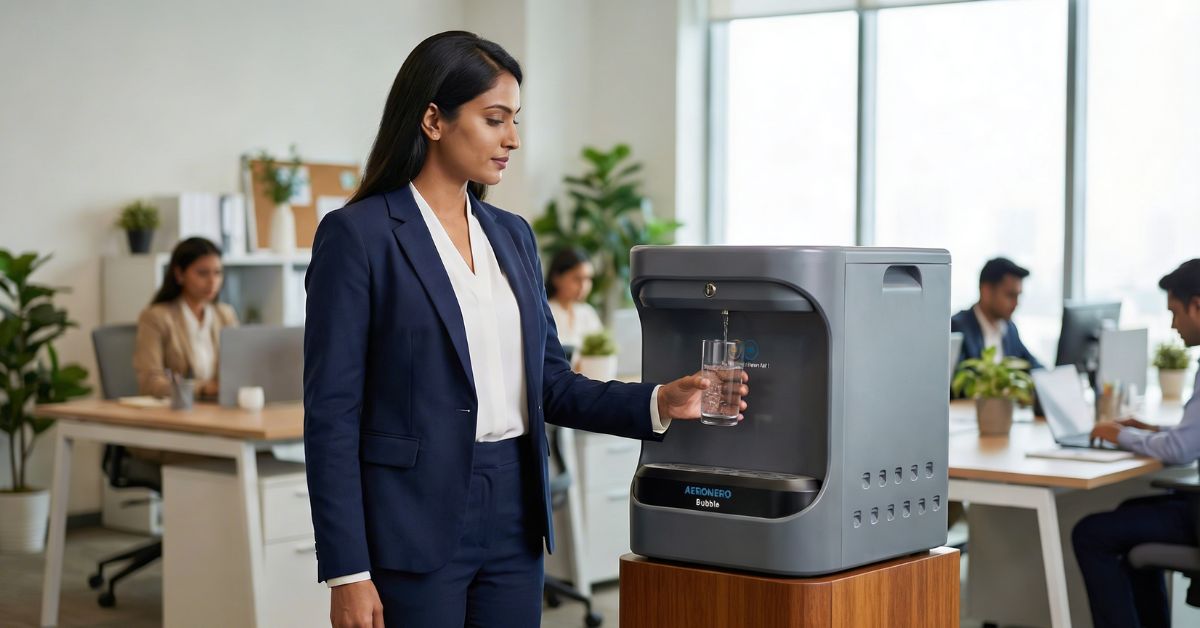
It sounds like something from a science-fiction movie. After all, air doesn't look like a source of water. Yet every day, the atmosphere around us contains invisible water vapour. With the right technology, that moisture can be captured, condensed into liquid water, purified, and turned into drinking water.
This technology is known as an Atmospheric Water Generator (AWG) or air-to-water generator.
The basic science is not imaginary. Atmospheric water generation uses the moisture already present in the air and converts it into liquid water. The U.S. Department of Energy describes atmospheric water generation as a method of extracting water vapour directly from air through processes such as condensation, desiccant capture, or membrane-based separation. It also notes that temperature and humidity influence how much water can be extracted and that energy requirements are an important consideration. (The Department of Energy's Energy.gov)
Companies such as Aeronero are taking this principle further by combining atmospheric moisture extraction with filtration, UV purification, and mineralisation to create drinking-water systems for homes, offices, institutions, and larger facilities.
So, how does water actually come out of air? Is it safe to drink? How much water can an air-to-water generator produce? And can this technology really become an alternative to bottled or conventional water supplies?
Let's break down the science and technology behind it.
What Is Water From Air?
Water-from-air technology is based on a simple fact: the atmosphere contains water vapour.
Even when the sky looks completely clear, the air around you can contain significant amounts of moisture. The amount depends primarily on temperature and relative humidity.
When humid air is cooled sufficiently, the water vapour within it can change from a gas into liquid droplets. This is called condensation.
You have probably seen the same process in everyday life.
Take a cold bottle out of a refrigerator and leave it in a humid room. After a while, tiny water droplets appear on the outside of the bottle.
Those droplets didn't come through the bottle.
They came from moisture in the surrounding air.
An atmospheric water generator applies this basic principle in a controlled system and then adds water-treatment technologies to make the collected water suitable for its intended use.
How Can Air Contain Enough Water to Drink?
This is one of the first questions people ask.
If air is mostly invisible, how can it contain enough water to fill a glass?
The answer is humidity.
Relative humidity describes how much moisture the air contains compared with the maximum amount it could hold at a particular temperature.
Warm air can hold more water vapour than cold air. Therefore, a warm and humid environment can provide considerably more atmospheric moisture for an AWG to capture.
This is also why an atmospheric water generator's production rate should never be considered a fixed number independent of climate.
The U.S. Department of Energy specifically notes that temperature and humidity affect how much water atmospheric water-generation systems can extract, along with the energy required by the system. (The Department of Energy's Energy.gov)
So yes, there can be enough water in the air to produce drinking water—but the quantity depends on the surrounding conditions and the technology being used.
How Does an Atmospheric Water Generator Work?
The basic process can be explained in six simple stages:
Air → Filtration → Moisture Extraction → Condensation → Purification → Mineralisation → Drinking Water
Aeronero's systems use a multi-stage process powered by its proprietary ConDessa™ Technology. Its current product information describes the process as air filtration, cooling and condensation, pre-carbon filtration, post-carbon filtration, ultra-UV purification, and mineralisation. (Aeronero)
Let's look at each stage.
Step 1: The Machine Takes in Atmospheric Air
The process begins when the atmospheric water generator draws surrounding air into the machine.
That air naturally contains water vapour, but it can also contain dust, airborne particles, and other contaminants.
That's why the first step is generally air filtration.
Aeronero says its systems filter incoming air to remove dust, airborne particles, and other contaminants before moisture extraction takes place. (Aeronero)
This is important because the system is not simply collecting whatever happens to be floating in the atmosphere.
It is designed to treat the incoming air as part of the water-generation process.
Step 2: Moisture Is Extracted Through Cooling and Condensation
Once the air has been filtered, the machine needs to separate the water vapour from it.
One way to do this is through cooling and condensation.
The system cools the air sufficiently for atmospheric moisture to condense into liquid water.
Aeronero describes its condensation stage as cooling filtered air to extract atmospheric moisture and convert it into fresh water. (Aeronero)
This is the key moment when invisible atmospheric water vapour becomes visible liquid water.
In simple terms:
Moist air + controlled cooling = condensed water
The resulting water can then be collected and sent through additional treatment stages.
What Is ConDessa™ Technology?
Aeronero has developed its proprietary ConDessa™ Technology for atmospheric water generation.
According to Aeronero, ConDessa is a hybrid approach that combines condensation and desiccation methods for atmospheric water generation. The company says this design is intended to improve water yield and reduce energy consumption, including in lower-humidity and remote environments. (Aeronero)
This is significant because the engineering challenge isn't simply proving that water can be condensed from air.
That basic principle has been understood for a long time.
The bigger challenge is making the process efficient, reliable, scalable, and suitable for real-world drinking-water applications.
Step 3: The Generated Water Goes Through Filtration
Once moisture has been converted into liquid water, the process isn't finished.
The newly generated water needs to go through additional treatment.
Aeronero's systems use pre-carbon and post-carbon filtration as part of their purification process.
According to the company, the pre-carbon stage helps remove chlorine, odours, and organic contaminants, while the post-carbon stage further improves taste and removes residual odours. (Aeronero)
This is important because collecting moisture from the atmosphere doesn't automatically guarantee that the resulting water meets drinking-water requirements.
Water generation and water purification are two separate parts of the process.
Step 4: UV Purification Adds Another Treatment Barrier
Aeronero's systems also include Ultra-UV purification.
The company says this stage is designed to eliminate bacteria and other harmful microorganisms. (Aeronero)
UV treatment is commonly used as a water-disinfection technology.
In an atmospheric water generator, adding UV treatment after filtration provides another layer of protection within the overall purification process.
This layered approach is important because safe drinking water requires more than simply removing visible particles.
Step 5: Minerals Are Added Back Into the Water
Another interesting part of the process is mineralisation.
Depending on the source and treatment process, water may contain relatively low levels of dissolved minerals.
Aeronero incorporates mineralisation into its water-treatment process and states that its systems enrich the water with essential minerals while maintaining an alkaline pH of 7.0–8.5. (Aeronero)
This can also help create a more balanced taste.
So the objective isn't simply:
Air → Water
It is more accurately:
Air → Atmospheric moisture → Liquid water → Filtration → Disinfection → Mineralisation → Drinking water
Can You Really Drink Water Made From Air?
Yes—atmospheric moisture can be converted into liquid water and subsequently treated for drinking-water applications.
However, an important distinction should be made.
Water being generated from air does not automatically mean that it is safe to drink.
The safety of the final water depends on the complete system, including:
- Air quality
- Moisture-extraction technology
- Filtration
- Disinfection
- Mineralisation
- Storage
- System cleanliness
- Maintenance
- Filter replacement
- Compliance with applicable drinking-water standards
Aeronero says its systems use multiple purification stages and are designed to produce clean, alkaline, mineral-rich drinking water. (Aeronero)
Users should always follow the manufacturer's maintenance instructions and applicable local drinking-water requirements.
How Much Water Can an Air-to-Water Generator Produce?
This is where things become more interesting.
The amount of water an AWG produces depends on the machine's design and environmental conditions.
For example, Aeronero's Bubble atmospheric water generator is rated for up to 20 litres per day at 80% relative humidity and 30°C. It is designed for domestic and small-office applications. (Aeronero)
Its Drizzle model is rated for up to 40 litres per day at 80% relative humidity and 30°C, with applications including domestic and commercial environments. (Aeronero)
For larger applications, Aeronero's Thunder is listed at up to 150 litres per day under the same reference humidity and temperature conditions. (Aeronero)
Its Airwell platform is designed for significantly larger deployments, with up to 500 litres per day per unit according to the current product information. (Aeronero)
This demonstrates that atmospheric water generation isn't limited to a small countertop appliance.
The technology can be designed across different scales.
Does Humidity Affect Water Production?
Absolutely.
This is one of the most important things to understand about making water from air.
An AWG is extracting water vapour that is already present in the atmosphere. If there is less available moisture, there is less water for the machine to capture.
The U.S. Department of Energy confirms that temperature and humidity influence atmospheric water extraction and that energy requirements must also be considered. (The Department of Energy's Energy.gov)
This is why manufacturers provide production figures alongside environmental conditions.
For example, when Aeronero states that Bubble can produce up to 20 litres per day, it specifies 80% relative humidity and 30°C as the reference condition. (Aeronero)
Therefore, consumers should always look beyond a headline production number and consider the conditions in which the machine will actually operate.
Is Making Water From Air Energy Efficient?
This is another reasonable question.
Air-to-water generation requires energy.
The machine needs to move air, extract moisture, operate its moisture-capture system, purify the resulting water, and manage storage and dispensing.
So atmospheric water isn't “free water” in the sense of requiring no energy.
However, the efficiency of the technology can vary substantially between systems.
Aeronero says its proprietary technology is designed to extract more water per unit of energy than conventional systems. (Aeronero)
When evaluating an AWG, users should therefore consider water production relative to energy consumption, not simply litres per day.
The environmental impact also depends on where the electricity comes from.
An AWG powered by renewable electricity can have a different overall environmental footprint from one powered entirely by carbon-intensive electricity.
Is Water From Air Better Than Bottled Water?
The comparison depends on what you value.
Bottled water is convenient and widely available, but it involves packaging, transportation, storage, and distribution.
An air-to-water generator creates water at the point of use.
Aeronero positions atmospheric water generation as a decentralised alternative that can reduce dependence on bottled water, tankers, and conventional groundwater sources. (Aeronero)
This can potentially reduce the need for:
- Single-use plastic bottles
- Water deliveries
- Large bottle storage
- Transportation of packaged water
- Repeated purchasing of bottled drinking water
For households and businesses trying to reduce packaged-water consumption, this can be a major advantage.
Is Air-to-Water Better Than RO?
Again, the answer depends on the application because the technologies do different jobs.
RO, or reverse osmosis, treats existing water.
An atmospheric water generator creates water from atmospheric moisture and then purifies it.
If you already have a reliable water source and need to remove dissolved substances, an RO purifier may be a practical solution.
If you want a decentralised drinking-water source that does not start with a conventional liquid-water supply, an AWG offers a different approach.
This is why atmospheric water generation should not necessarily be viewed as a direct replacement for every water-treatment technology.
It is an alternative method of water sourcing combined with purification.
Does Water From Air Taste Different?
Taste can depend on the mineral composition and purification process.
Water that has been heavily purified may have a different taste from mineral-rich water.
Aeronero incorporates mineralisation into its purification process and says its systems provide balanced minerals and maintain an alkaline pH of 7.0–8.5. (Aeronero)
This is intended to create a more balanced drinking-water profile.
Of course, taste is subjective, and the final profile can depend on the specific system, mineralisation process, maintenance, and individual preferences.
Can Air-to-Water Generators Work in Homes?
Yes.
Aeronero specifically offers compact systems for residential applications.
Its Bubble model is designed for homes and small offices and is rated for up to 20 litres of water per day under specified conditions. (Aeronero)
This makes the technology particularly interesting for households that:
- Regularly buy bottled water
- Want a decentralised drinking-water source
- Have suitable humidity conditions
- Want to reduce plastic consumption
- Have access to reliable electricity
- Prefer producing water at the point of use
The machine's actual suitability should always be evaluated against the household's daily water demand and local environmental conditions.
Can Businesses Use Water From Air?
Yes, and this is where atmospheric water generation becomes even more interesting.
Aeronero's current product portfolio includes systems designed for offices, restaurants, cafés, schools, hospitals, factories, NGOs, communities, and larger facilities. (Aeronero)
For example, Drizzle is designed for commercial applications and is rated for up to 40 litres per day, while Thunder is designed for larger commercial and industrial applications and can produce up to 150 litres per day under specified conditions. (Aeronero)
Airwell takes the concept further with modular systems designed for high-volume deployments. (Aeronero)
This scalability is one of the strongest arguments for atmospheric water technology.
The same basic concept can be adapted to different water requirements.
Can Water From Air Help Reduce Plastic Waste?
Potentially, yes.
If water is generated at the point of use and dispensed into reusable containers, there may be less need for single-use plastic bottles.
Aeronero's Aquair platform, for example, promotes on-site production and packaging options that avoid conventional single-use plastic bottles. (Aeronero)
The broader sustainability benefit depends on the full lifecycle of the system, including electricity consumption, maintenance, component replacement, and eventual equipment disposal.
Nevertheless, replacing repeated deliveries of packaged drinking water with local water generation can significantly change the logistics and packaging model.
Is Air-to-Water Technology a New Idea?
The idea of extracting moisture from air isn't new.
Condensation occurs naturally every day.
What is changing is the engineering around atmospheric water generation.
Modern systems can combine:
- Advanced air handling
- Moisture extraction
- Condensation
- Desiccation
- Filtration
- Carbon treatment
- UV disinfection
- Mineralisation
- Sensors
- IoT monitoring
- Automated controls
Aeronero's current systems combine atmospheric moisture extraction with a multi-stage purification process and IoT monitoring. (Aeronero)
The innovation therefore lies not in discovering that air contains water.
The innovation lies in making that water accessible, treatable, scalable, and useful in real-world environments.
What Are the Limitations of Making Drinking Water From Air?
It's important to look at the technology realistically.
Atmospheric water generators have several factors that need to be considered.
Humidity
Lower humidity generally means less atmospheric moisture is available for extraction.
Temperature
Temperature affects how much moisture air can hold and the performance of moisture-extraction systems.
Electricity
AWGs require electricity to operate.
Production Capacity
Every system has a maximum output, and the actual output depends on environmental conditions.
Maintenance
Filters, water-contact components, and other system elements require appropriate maintenance.
Water Quality
The generated water still needs proper treatment, storage, and hygiene management.
These aren't reasons to dismiss the technology. They are simply important factors to consider when selecting an air-to-water generator.
Why Air-to-Water Technology Matters for the Future
The biggest idea behind atmospheric water generation is decentralisation.
Traditional water infrastructure often relies on large central systems.
Water is collected, treated, transported through pipelines or tankers, stored, and eventually delivered to consumers.
An AWG introduces another possibility:
Generate water where it is needed.
For homes, offices, schools, remote facilities, hospitals, communities, and industrial sites, that can provide an additional source of drinking water.
Aeronero describes its technology as a decentralised approach to water generation and offers products ranging from compact household systems to high-capacity industrial platforms. (Aeronero)
This could become increasingly valuable as communities and businesses look for more resilient approaches to water security.
Aeronero: Turning Atmospheric Moisture Into Drinking Water
Aeronero's technology demonstrates how the concept of water from air can move beyond theory and into practical applications.
Its proprietary ConDessa™ Technology combines atmospheric moisture extraction with purification and mineralisation. Aeronero says its hybrid approach incorporates condensation and desiccation methods to improve water yield and energy performance. (Aeronero)
The product range illustrates the scalability of the technology:
- Bubble: Up to 20 litres/day for homes and small offices
- Drizzle: Up to 40 litres/day for domestic and commercial applications
- Thunder: Up to 150 litres/day for larger commercial and industrial applications
- Airwell: Up to 500 litres/day per unit for high-volume applications (Aeronero)
This range shows that atmospheric water generation can be designed for different scales rather than being limited to one type of consumer.
Frequently Asked Questions
Can you really make water from air?
Yes. Air contains water vapour, and atmospheric water generators can extract that moisture and convert it into liquid water through processes such as condensation. (The Department of Energy's Energy.gov)
Is water made from air safe to drink?
It can be treated for drinking-water applications, but safety depends on the complete system, purification process, maintenance, storage, and applicable quality standards. Aeronero uses filtration, carbon treatment, UV purification, and mineralisation in its systems. (Aeronero)
How much water can an AWG produce?
Production varies by model and environmental conditions. Aeronero's Bubble is rated for up to 20 litres/day, while larger systems can produce substantially more. (Aeronero)
Does humidity affect water production?
Yes. Humidity and temperature have a direct impact on atmospheric water extraction. (The Department of Energy's Energy.gov)
Does an atmospheric water generator need electricity?
Yes. Electricity is required to operate the system's air handling, moisture extraction, purification, and associated components.
Can an AWG replace bottled water?
For users whose daily drinking-water needs can be met by the system, it can significantly reduce dependence on bottled water and the associated packaging and delivery requirements.
Can an AWG replace an RO purifier?
Not necessarily. An RO purifier treats existing water, while an AWG generates water from atmospheric moisture and then purifies it. The right choice depends on the user's water source and requirements.
Conclusion: Yes, You Really Can Make Drinking Water From Air
So, can you really make drinking water from air?
Yes.
The science is based on something that happens naturally all around us: water vapour exists in the atmosphere, and that moisture can be converted into liquid water through controlled extraction and condensation. (The Department of Energy's Energy.gov)
Modern atmospheric water generators take that natural process several steps further. They filter incoming air, extract atmospheric moisture, purify the resulting water, disinfect it, and in systems such as Aeronero's, add minerals to create a balanced drinking-water profile. (Aeronero)
The technology isn't magic, and it isn't completely independent of environmental conditions or energy. Humidity, temperature, electricity, system capacity, maintenance, and water-quality management all matter.
But the fundamental idea is very real.
Aeronero's ConDessa™-powered systems demonstrate how air-to-water technology can turn atmospheric moisture into a decentralised source of drinking water, from compact household systems such as Bubble to larger platforms designed for commercial and industrial applications. (Aeronero)
As the world searches for more resilient and sustainable approaches to water access, the question may eventually change from “Can you make drinking water from air?” to “Where can water-from-air technology make the biggest difference?”