
How Aeronero Bubble Generates Clean Drinking Water from Air for Homes and Small Offices
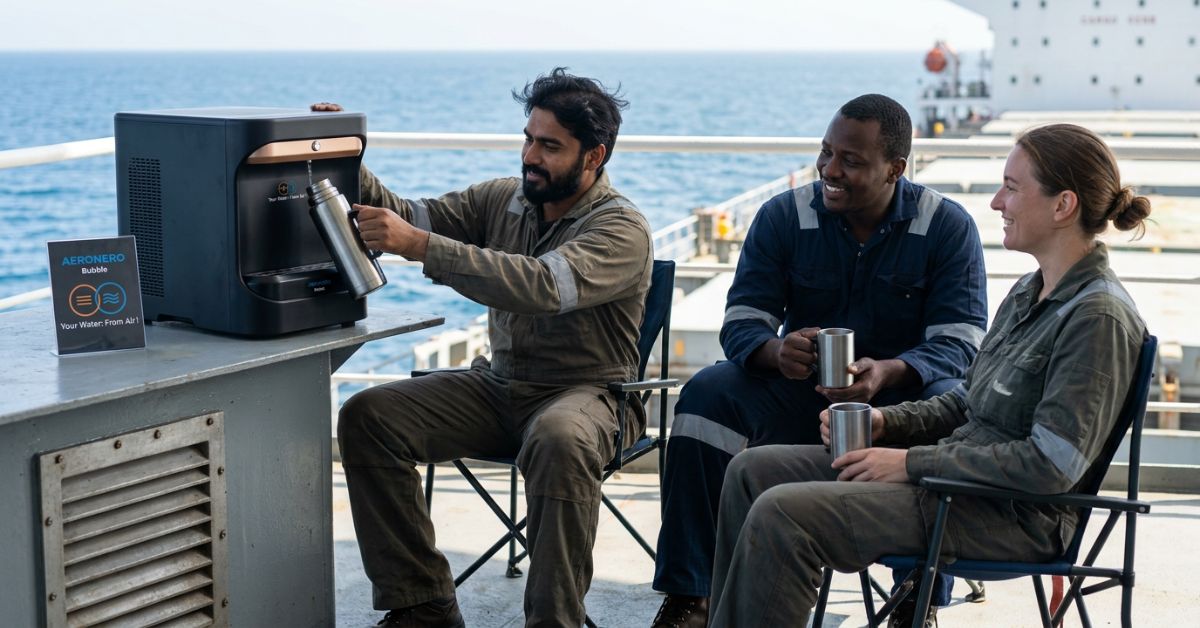
What if your next glass of drinking water could come from the air around you?
It sounds futuristic, but atmospheric water generation (AWG) is making this idea possible. Instead of depending entirely on groundwater, municipal pipelines, water tankers, or bottled water, an atmospheric water generator extracts moisture naturally present in the surrounding air and converts it into drinking water through a controlled purification process.
For homes and small offices, one of the most interesting solutions in this space is Aeronero Bubble. Designed specifically for domestic and smaller commercial environments, Bubble can produce up to 20 litres of clean, alkaline, mineral-rich drinking water per day under specified conditions. (Aeronero)
But how does a machine actually turn humidity into drinking water?
The answer lies in a combination of atmospheric moisture extraction, condensation, multi-stage filtration, UV purification, and mineralisation. Aeronero's proprietary ConDessa™ Technology is at the centre of this process.
In this article, we'll explain how the Aeronero Bubble works, how water is generated from air, the purification stages involved, its specifications, and why this technology can be useful for modern homes and small offices.
What Is an Atmospheric Water Generator?
An Atmospheric Water Generator, commonly called an AWG, is a system that captures moisture from the air and converts it into liquid water.
Air naturally contains water vapour. The amount varies depending on factors such as temperature and relative humidity. When humid air is cooled sufficiently, the moisture in it can condense into liquid water.
This is similar to what happens when water droplets form on the outside of a cold glass on a humid day.
An AWG essentially uses this natural principle in a controlled technological system.
However, producing drinking water involves more than simply collecting condensed moisture. The incoming air must be filtered, the generated water must be purified, and the final water may need mineral balancing.
That's why a modern AWG combines air handling, condensation, filtration, disinfection, and water treatment into one system.
What Is Aeronero Bubble?
Aeronero Bubble is an atmospheric water generation system designed for homes and small offices.
According to Aeronero's product information, Bubble can generate up to 20 litres of drinking water per day at 80% relative humidity and 30°C. It operates on a single-phase AC power supply and has a 12-litre tank according to the current product specifications. (Aeronero)
The system is designed around Aeronero's proprietary ConDessa™ Technology and includes IoT monitoring capabilities. (Aeronero)
Rather than receiving water through a conventional external supply, Bubble uses moisture already present in the atmosphere as its starting point.
This creates a decentralised approach to drinking-water production: water can be generated where it is needed.
How Does Aeronero Bubble Make Water From Air?
The basic concept is surprisingly simple:
Air → Moisture → Condensation → Filtration → Purification → Mineralisation → Drinking Water
Aeronero's Bubble uses a multi-stage process to turn atmospheric moisture into drinking water.
The current product page describes six main stages:
- Air filtration
- Cooling and condensation
- Pre-carbon filtration
- Post-carbon filtration
- Ultra-UV purification
- Mineralisation (Aeronero)
Each stage has a specific role.
Let's look at the process in detail.
Step 1: Air Filtration Removes Airborne Particles
The process begins by drawing surrounding air into the system.
But the air around us can contain dust, airborne particles, and other contaminants. Before atmospheric moisture is extracted, the incoming air therefore passes through an air-filtration stage.
According to Aeronero, this stage removes dust, airborne particles, and other contaminants from incoming air. (Aeronero)
This is an important first step because the quality of the surrounding air can influence the overall water-generation process.
Think of it as preparing the raw material before the water extraction process begins.
The filtered air then moves toward the moisture-extraction stage.
Step 2: Cooling and Condensation Extract Moisture From Air
This is the stage where the concept of water from air becomes tangible.
Air contains invisible water vapour. When the filtered air is cooled to an appropriate temperature, that water vapour can condense into liquid water.
Aeronero describes this stage as cooling the filtered air to extract atmospheric moisture and convert it into fresh water. (Aeronero)
The principle is similar to condensation in nature.
Warm, moisture-containing air comes into contact with a sufficiently cool surface. Water vapour changes from a gas into liquid droplets.
Those droplets can then be collected and moved through the subsequent purification stages.
This is the core of an atmospheric water generator.
The Role of Humidity in Water Production
One important point to understand about atmospheric water generation is that production depends on environmental conditions.
Aeronero specifies Bubble's maximum production of up to 20 litres per day at 80% relative humidity and 30°C. (Aeronero)
That means the stated maximum output should not be interpreted as a guaranteed fixed production rate in every climate.
Humidity matters because the machine is extracting water vapour from the air. Higher moisture availability generally provides more water for the system to capture.
This makes environmental conditions an important consideration when evaluating any atmospheric water generator.
Step 3: Pre-Carbon Filtration Helps Improve Water Quality
After moisture has been condensed into water, the generated water moves through additional treatment stages.
Aeronero's Bubble process includes a pre-carbon filter.
According to the product page, this stage helps remove chlorine, odours, and organic contaminants, contributing to cleaner and better-tasting water. (Aeronero)
Carbon filtration is widely used in water treatment because activated carbon can help reduce certain unwanted compounds that affect taste and odour.
This stage is therefore not about generating the water itself. Instead, it is about improving the quality and sensory characteristics of the generated water.
Step 4: Post-Carbon Filtration Further Improves Taste
Bubble also incorporates a post-carbon filtration stage.
Aeronero says this stage enhances drinking-water taste, removes residual odours, and helps ensure fresh, clean water. (Aeronero)
Using multiple treatment stages creates a layered purification approach.
Rather than expecting one filter to perform every function, different stages are assigned different roles.
This is particularly relevant for drinking water because consumers care about more than basic cleanliness. Taste, odour, mineral balance, and consistency can all influence whether people enjoy and regularly consume the water.
Step 5: Ultra-UV Purification Targets Microorganisms
Water quality isn't only about visible particles or taste.
Microorganisms are another important consideration when producing drinking water.
Aeronero Bubble includes an Ultra-UV purification stage. Aeronero states that this stage is designed to eliminate bacteria and other harmful microorganisms. (Aeronero)
UV-based water treatment uses ultraviolet light as a disinfection method.
The benefit of including UV technology in a multi-stage water-generation system is that it adds another treatment barrier after filtration.
This layered approach is an important part of the overall purification process.
Step 6: Mineralisation Adds Essential Minerals
After purification, Bubble's process includes mineralisation.
Pure water can sometimes have a flat taste, depending on how it has been produced and treated. Mineralisation can help create a more balanced drinking-water profile.
Aeronero states that its mineralisation stage enriches the water with essential minerals and maintains an alkaline pH of 7.0–8.5. (Aeronero)
This is one of the differences between simply collecting atmospheric condensation and creating a finished drinking-water product.
The objective is not merely to capture moisture.
It is to transform atmospheric moisture into clean, mineral-balanced drinking water through a controlled process.
What Is ConDessa™ Technology?
At the centre of Aeronero's AWG systems is its proprietary ConDessa™ Technology.
Aeronero describes ConDessa™ as its proprietary atmospheric water technology and says the system replicates aspects of the natural water cycle to generate water from atmospheric moisture. (Aeronero)
The company's technology information also describes the broader process around condensation, filtration, carbon treatment, and mineralisation. (Aeronero)
Aeronero's company information describes ConDessa™ as a hybrid system incorporating condensation and desiccation methods for atmospheric water generation, with the goal of improving water yield and energy performance across different humidity conditions. (Aeronero)
This technology is important because efficient atmospheric water generation depends on more than simply cooling air.
The engineering challenge is extracting useful quantities of moisture while managing energy consumption and maintaining appropriate water quality.
How Much Water Can Aeronero Bubble Produce?
Aeronero Bubble is rated for up to 20 litres of water per day under the specified condition of 80% relative humidity and 30°C. (Aeronero)
This makes the system particularly relevant to smaller-scale requirements.
For example, it could potentially be considered for:
- Homes
- Apartments
- Small offices
- Home offices
- Studios
- Small workspaces
- Drinking-water stations
The actual output can vary based on environmental conditions and system operation.
For a household, 20 litres per day represents a meaningful volume for regular drinking-water needs.
For a small office, it can provide a decentralised drinking-water source without requiring the organisation to depend entirely on packaged water.
Aeronero Bubble Specifications at a Glance
Here are the key specifications currently listed by Aeronero:
These specifications are taken from Aeronero's current Bubble product page. (Aeronero)
Why Is Bubble Suitable for Homes?
One of the biggest advantages of a home-focused atmospheric water generator is convenience.
Instead of repeatedly buying bottled drinking water or arranging external water supplies, a household can generate water on-site.
Bubble is designed specifically for domestic and commercial applications and provides a compact alternative to larger AWG systems. (Aeronero)
For households interested in reducing dependence on packaged drinking water, an AWG can also support a more decentralised approach to hydration.
The machine can be placed within the home and used as a dedicated drinking-water source.
For families, the appeal is straightforward: air is available around you, and Bubble is designed to extract moisture from that air and process it into drinking water.
Why Could Bubble Be Useful for Small Offices?
Small offices have different water requirements from large commercial buildings.
A team may need a reliable source of drinking water throughout the working day, but installing a large-scale water-generation system may not be practical.
Bubble is designed for smaller applications and can produce up to 20 litres daily under specified conditions. (Aeronero)
This can make it relevant for:
Small businesses: Provide drinking water for employees without relying exclusively on bottled supplies.
Startups: Add a modern water solution without requiring a large industrial installation.
Home offices: Maintain an independent drinking-water source while working from home.
Small studios: Support staff and visitors with on-site drinking water.
The right capacity ultimately depends on the number of users and daily consumption.
Atmospheric Water vs Bottled Water
Bottled water is convenient, but it also requires packaging, transportation, storage, and repeated purchasing.
Atmospheric water generation takes a different approach.
Instead of delivering water to the user, the system generates water at the point of use.
This can create a decentralised water model, which is one of the major attractions of AWG technology.
Aeronero describes its AWG systems as providing a dependable decentralised water supply and offers systems ranging from compact domestic units to much larger industrial solutions. (Aeronero)
For a home or small office, Bubble represents the compact end of that product ecosystem.
Does Bubble Need a Traditional Water Connection?
The fundamental attraction of an atmospheric water generator is that its water source is moisture in the atmosphere, rather than a conventional incoming water pipeline.
Bubble's process begins with air filtration and then uses cooling and condensation to extract atmospheric moisture. (Aeronero)
This means the concept is fundamentally different from a conventional water purifier, which typically starts with an existing water supply.
An AWG is therefore better understood as a water-generation and purification system, rather than simply a filtration appliance.
What Makes Air-to-Water Technology Different?
Traditional water purification and atmospheric water generation solve different problems.
A conventional purifier takes available water and treats it.
An atmospheric water generator first creates water from atmospheric moisture and then purifies it.
The distinction is important.
The process can be represented simply as:
Traditional purifier:
Existing water → Filtration → Purified water
Atmospheric water generator:
Air → Moisture extraction → Condensation → Filtration → Disinfection → Mineralisation → Drinking water
This is why atmospheric water generation is often described as air-to-water technology.
Is Atmospheric Water Generation the Future of Home Drinking Water?
The increasing interest in AWG technology reflects a broader shift toward decentralised resource solutions.
Homes and businesses are looking for ways to become less dependent on centralised supply chains.
The concept has particular relevance in areas where water infrastructure is unreliable, water quality is a concern, or bottled water dependence is high.
However, atmospheric water generation is not a universal replacement for every water source.
Its practicality depends on factors including humidity, temperature, electricity availability, water requirements, maintenance, and operating conditions.
For this reason, consumers should evaluate the system based on their specific environment and expected water consumption.
The Bigger Idea Behind Aeronero Bubble
Bubble is more than a machine that produces drinking water.
It represents a different way of thinking about how water can be sourced.
Instead of asking:
“Where can we get water?”
Atmospheric water technology asks:
“How can we extract usable water from the resources already available around us?”
Air is everywhere, and it naturally contains moisture.
The challenge is developing technology that can efficiently capture that moisture and turn it into safe, usable water.
Aeronero's approach combines atmospheric moisture extraction with multiple purification stages and mineralisation, creating a complete air-to-water system rather than a simple condensation device. (Aeronero)
Bubble and the Future of Decentralised Drinking Water
The future of drinking-water technology may increasingly involve decentralised systems.
Instead of depending on one central source, homes, offices, institutions, and communities can potentially use different technologies according to their local conditions.
Aeronero's product portfolio illustrates this scalable approach. Bubble is positioned for homes and small offices, while larger systems such as Drizzle, Thunder, and Airwell are designed for progressively larger applications. (Aeronero)
This creates an ecosystem where water generation capacity can match the scale of demand.
For a family, a compact unit may be enough.
For a small office, a higher-capacity system may make more sense.
For larger institutions, industrial-scale atmospheric water generation can provide significantly greater output.
Final Thoughts: Turning Air Into Drinking Water
Aeronero Bubble demonstrates how advances in atmospheric water generation technology are changing the way people can think about drinking water.
The process starts with something that surrounds us every day: air.
Bubble filters incoming air, extracts atmospheric moisture through cooling and condensation, processes the resulting water through carbon filtration and UV purification, and finally adds minerals to create a balanced drinking-water profile. (Aeronero)
With a stated capacity of up to 20 litres per day at 80% relative humidity and 30°C, Bubble is designed specifically for homes and small offices looking for a decentralised drinking-water solution. (Aeronero)
As water security, resource efficiency, and sustainable living become increasingly important, technologies that can generate water locally may become an increasingly valuable part of the conversation.
Aeronero Bubble turns atmospheric moisture into a practical source of drinking water-and brings the concept of “water from air” directly into homes and small workplaces.