
Why Airwell Is a Smart Water-from-Air Solution for Hospitals, Industries and Large Communities
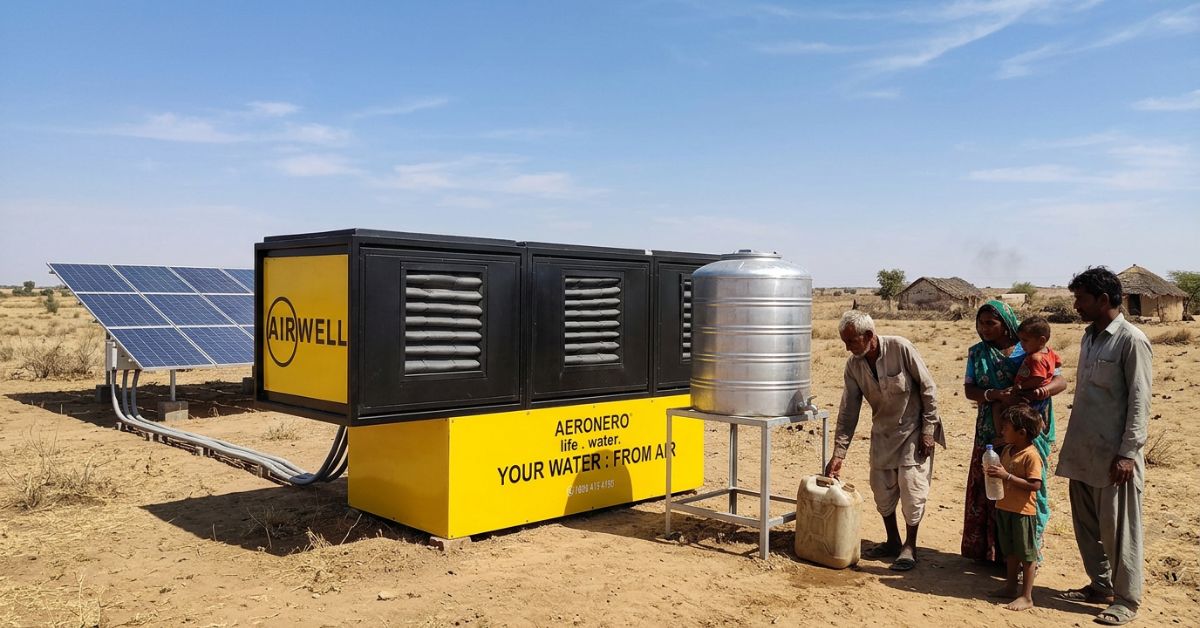
Access to reliable drinking water is becoming an increasingly important concern for hospitals, industrial facilities, large residential communities, corporate campuses, and public infrastructure.
Traditional water systems can depend on municipal pipelines, groundwater, tankers, packaged water, or other external sources. When those sources become unreliable, expensive, or difficult to manage, organisations need alternatives that can provide drinking water closer to where it is actually consumed.
This is where water-from-air technology offers an interesting solution.
An Atmospheric Water Generator (AWG) extracts moisture naturally present in the atmosphere, converts it into liquid water, and then treats that water through multiple purification stages. Aeronero's Airwell takes this concept into the industrial and large-scale space with a modular system capable of producing up to 500 litres of water per day per unit under specified conditions of 80% relative humidity and 30°C. The company says Airwell can be scaled through multiple units to deliver approximately 5,000–10,000 litres per day, depending on customer requirements. (Aeronero)
For hospitals, industries, offices, gated communities, NGOs, railway projects, village developments, and security forces, this scalability is one of Airwell's most important features.
But what makes Airwell a smart water-from-air solution?
Let's explore how the technology works, where it can be used, and why decentralised drinking-water generation could become increasingly important.
What Is Airwell?
Aeronero Airwell is a modular atmospheric water generation system designed for industrial-scale drinking-water production.
Unlike a conventional RO purifier, Airwell does not begin with an existing liquid-water source. Instead, it extracts moisture from the surrounding atmosphere.
The current Airwell product page lists a capacity of 500 litres per day at 80% relative humidity and 30°C, with a 300-litre tank and multi-stage filtration. The system is designed for industrial use and supports both single-phase and three-phase AC power configurations. (Aeronero)
Its modular architecture is particularly relevant for large organisations.
Instead of installing one massive system regardless of demand, organisations can use a scalable deployment model based on their actual requirements.
Aeronero says Airwell can be configured to deliver 5,000 to 10,000 litres of potable water per day through a scalable, stackable approach. (Aeronero)
How Does Airwell Make Drinking Water From Air?
The concept behind Airwell is easier to understand than it may initially sound.
The atmosphere contains water vapour. When humid air is cooled appropriately, that vapour can condense into liquid water.
Airwell uses Aeronero's proprietary ConDessa™ Technology and a multi-stage treatment process to capture atmospheric moisture and convert it into drinking water. (Aeronero)
The basic process is:
Air → Filtration → Cooling & Condensation → Carbon Filtration → UV Purification → Mineralisation → Drinking Water
The process has six stages on Aeronero's current Airwell product page.
Step 1: Air Filtration
The first stage involves filtering the incoming atmospheric air.
Air naturally contains dust, particles, and other airborne contaminants. Air filtration helps remove these unwanted particles before the moisture-extraction process.
Aeronero states that this stage removes dust, airborne particles, and other contaminants from incoming air. (Aeronero)
This is an important first step because an atmospheric water generator needs to manage not only the moisture in air but also the quality of the air entering the machine.
Step 2: Cooling and Condensation
The filtered air then goes through the moisture-extraction stage.
Airwell cools the air to extract atmospheric moisture, converting water vapour into liquid water. (Aeronero)
This is the fundamental principle behind an air-to-water generator.
The water doesn't come from a pipeline or borewell. It begins as invisible moisture already present in the atmosphere.
Step 3: Pre-Carbon Filtration
Once water has been generated, it undergoes additional treatment.
Airwell uses a pre-carbon filtration stage designed to remove chlorine, odours, and organic contaminants, helping improve the resulting water's quality and taste. (Aeronero)
Step 4: Post-Carbon Filtration
A post-carbon filtration stage follows.
According to Aeronero, this stage further improves drinking-water taste and removes residual odours. (Aeronero)
Using multiple treatment stages allows the system to address different water-quality considerations rather than relying on a single filtration technology.
Step 5: Ultra-UV Purification
Water treatment isn't only about taste and visible impurities.
Microorganisms also need to be considered.
Airwell incorporates Ultra-UV purification, which Aeronero says is designed to eliminate bacteria and other harmful microorganisms. (Aeronero)
This provides another treatment barrier before the water reaches the dispensing stage.
Step 6: Mineralisation
The final listed stage is mineralisation.
Aeronero says Airwell enriches the water with essential minerals and maintains an alkaline pH of 7.0–8.5. (Aeronero)
The objective is therefore not simply to remove unwanted substances. The system is designed to produce clean, mineral-rich drinking water with a balanced taste profile.
Why Airwell Makes Sense for Hospitals
Hospitals have particularly demanding water requirements.
Patients, doctors, nurses, administrative teams, visitors, and support staff can all contribute to significant daily drinking-water consumption.
At the same time, hospitals cannot afford to treat water availability as a minor operational issue.
An additional decentralised source of drinking water can therefore be valuable.
1. Support for Decentralised Water Supply
Airwell can generate drinking water directly at the facility rather than depending entirely on external packaged-water deliveries.
Aeronero specifically lists hospitals among the intended applications for Airwell. (Aeronero)
This can help hospitals build greater resilience into their drinking-water infrastructure.
It should be noted that an AWG intended for drinking water is not automatically a substitute for every type of water required in a hospital. Clinical, sanitation, sterilisation, laboratory, and other specialised applications can have different water-quality requirements.
Airwell is best considered as part of a broader water strategy, particularly for potable drinking-water needs.
2. Reduce Bottled-Water Logistics
Large hospitals may consume substantial quantities of packaged drinking water.
That creates an ongoing cycle of:
Ordering → Delivery → Storage → Distribution → Bottle collection → Disposal or recycling
Generating water on-site can potentially reduce some of that logistical burden.
Reusable dispensing systems can further reduce dependence on single-use packaging.
3. Reliable Local Production
Water generated on-site can provide an additional layer of resilience when external supplies face disruption.
For hospitals operating continuously, having multiple sources or backup strategies for drinking water can be an important part of operational planning.
Why Airwell Is Suitable for Industrial Facilities
Industries often operate large campuses with hundreds or thousands of employees.
Factories, manufacturing plants, warehouses, and industrial estates can therefore have substantial drinking-water requirements.
Airwell's industrial positioning and modular scalability make it relevant to these environments. (Aeronero)
1. High Daily Production
A single Airwell unit is listed at up to 500 litres per day under the specified reference conditions. (Aeronero)
That is significantly higher than the capacity of many household-focused AWG systems.
For larger facilities, multiple units can be deployed as required.
2. Scalable Deployment
One of Airwell's biggest advantages is its modular design.
Aeronero says the system can be scaled to approximately 5,000–10,000 litres per day according to customer requirements. (Aeronero)
This means organisations can consider a deployment based on actual demand instead of being restricted to a single fixed capacity.
For example, a large industrial campus might begin with a smaller deployment and expand as demand grows.
3. Outdoor Installation
Airwell is engineered for outdoor installation, with an optional dispenser designed for indoor or outdoor use. (Aeronero)
This provides flexibility for facilities where indoor floor space is limited.
Airwell for Large Communities and Gated Communities
Large residential communities face a different challenge from individual households.
A community may have hundreds or thousands of residents, creating substantial demand for drinking water.
Instead of every household purchasing bottled water separately, a community can explore centralised or decentralised atmospheric water-generation infrastructure.
Aeronero specifically identifies gated communities and village developments among Airwell's potential applications. (Aeronero)
Community-Level Water Generation
A modular AWG installation can potentially serve shared drinking-water points.
This could include:
- Community hydration stations
- Residential campuses
- Shared public areas
- Security facilities
- Clubhouses
- Community centres
- Institutional campuses
The exact deployment model depends on the site's requirements, local regulations, electricity supply, humidity, and water consumption.
Airwell and Water Independence
One of the strongest arguments for water-from-air technology is water independence.
Complete independence isn't realistic because atmospheric water generators still depend on factors such as electricity, humidity, maintenance, and equipment availability.
However, an AWG can reduce dependence on a single conventional water source.
Aeronero positions its systems as a dependable, decentralised water supply, including for hospitals and government deployments. (Aeronero)
This can be particularly valuable when organisations want to diversify their drinking-water sources.
Instead of:
One supply source → One point of failure
the organisation can move toward:
Conventional supply + Atmospheric water generation + Storage + Backup systems
That is a much more resilient approach.
Airwell vs Bottled Water
Bottled water is convenient, but large-scale bottled-water consumption creates logistical and environmental challenges.
Water must be packaged and transported before it reaches the customer.
For hospitals, industries, and communities, this can mean regular deliveries and substantial storage requirements.
Airwell offers a different model:
Generate → Purify → Store → Dispense
The water is generated at or near the location where it is required.
This can potentially reduce:
- Bottle transportation
- Storage requirements
- Delivery schedules
- Packaging consumption
- Handling of empty bottles
The overall environmental impact still depends on electricity consumption, equipment lifecycle, maintenance, and the source of electricity used to operate the AWG.
Airwell vs Conventional RO Systems
It is important not to treat Airwell and RO as identical technologies.
An RO system purifies an existing water source.
An atmospheric water generator creates water from atmospheric moisture before purifying it.
That difference is fundamental.
RO can be an effective choice when a facility already has a suitable water source and needs treatment for dissolved contaminants.
Airwell becomes interesting when an organisation wants to create a decentralised drinking-water source without relying entirely on incoming liquid water.
In some situations, the technologies could even be considered complementary rather than mutually exclusive.
The appropriate solution depends on:
- Existing water quality
- Local water availability
- Daily demand
- Electricity availability
- Humidity
- Regulatory requirements
- Installation conditions
- Budget
- Maintenance capabilities
Energy Efficiency and Airwell
Any serious discussion of atmospheric water generation must include energy.
AWGs require power to operate their air-handling and moisture-extraction systems, as well as water treatment and controls.
Airwell's current specifications list 7,000 W power consumption and a 500 L/day production capacity under specified environmental conditions. (Aeronero)
Aeronero also states that its proprietary technology is designed to extract more water per unit of energy than conventional systems. (Aeronero)
For a hospital, industrial facility, or community, the important calculation isn't simply the machine's power rating.
Decision-makers should evaluate:
Energy consumed per litre of water produced
under the actual environmental conditions of the installation.
Humidity and temperature can affect atmospheric water generation, so real-world performance should be evaluated against the manufacturer's specified operating conditions.
What Makes Airwell Scalable?
Scalability is perhaps Airwell's most important differentiator.
A small household may need only a few litres of drinking water per day.
A hospital may need hundreds or thousands.
A factory may need water for employees across multiple shifts.
A gated community may require a shared drinking-water infrastructure.
A single fixed-size machine cannot efficiently address every requirement.
Airwell's modular and stackable design allows the system to be configured for larger demand. Aeronero states that deployments can reach approximately 5,000–10,000 litres per day depending on customer requirements. (Aeronero)
This makes the platform particularly relevant to large-scale water projects.
Airwell's Storage Capacity
Water production and water consumption don't always happen at the same rate.
For example, demand may increase sharply during:
- Office hours
- Hospital visiting hours
- Factory shifts
- School breaks
- Community events
Airwell's current product specifications list a 300-litre tank capacity. (Aeronero)
This storage capacity can provide a buffer between water generation and immediate consumption.
For larger installations, overall storage requirements should be planned according to the site's consumption pattern and operational needs.
Smart Monitoring With IoT
Modern industrial infrastructure is increasingly connected.
Airwell is described as being powered by patented ConDessa™ Technology and IoT monitoring. (Aeronero)
IoT capabilities can be valuable for large deployments because facility managers may need visibility into equipment performance, production, maintenance, and operational status.
For an organisation with multiple AWG units across a large campus, smart monitoring can make the system easier to manage than relying entirely on manual checks.
This becomes even more important as an installation scales from one unit to multiple units.
Durable Construction for Industrial Applications
Airwell is designed for industrial use rather than being treated simply as a household appliance.
The current specifications list a durable stainless-steel body and food-grade water tank construction. The listed net weight is approximately 400 kg, with dimensions of 2300 × 710 × 610 mm and a noise level of up to 70 dB. (Aeronero)
These specifications matter when planning installation.
Large facilities need to consider:
- Available floor or outdoor space
- Electrical connections
- Access for maintenance
- Water dispensing locations
- Noise considerations
- Weather exposure
- Security
- Drainage and surrounding infrastructure
Proper site planning is essential for any industrial water-generation installation.
Who Can Benefit From Airwell?
Airwell's target applications extend well beyond traditional corporate offices.
Hospitals
For supplementary potable drinking-water production and decentralised hydration infrastructure.
Industries
For factories and manufacturing facilities with substantial employee drinking-water requirements.
Large Communities
For gated communities and village developments that need shared drinking-water infrastructure.
Corporate Campuses
For large office complexes and corporate facilities looking to reduce dependence on packaged water.
NGOs
For organisations working on water-access projects or community infrastructure.
Railways
For railway-related facilities and projects where decentralised drinking-water generation may be valuable.
Security Forces
For facilities requiring reliable drinking-water infrastructure in potentially challenging locations.
Aeronero explicitly lists these sectors among Airwell's intended applications. (Aeronero)
Why Airwell Can Be a Smart Sustainability Investment
Sustainability isn't simply about eliminating one environmental problem.
A genuinely sustainable water strategy should consider the entire lifecycle:
Water source → Energy → Equipment → Transportation → Packaging → Consumption → Waste
Airwell can change several elements of that equation.
By generating water locally, it can potentially reduce dependence on transported packaged water.
By dispensing into reusable containers, it can help reduce single-use plastic consumption.
By sourcing water from atmospheric moisture, it can provide an alternative to conventional groundwater-based drinking-water sourcing.
And by using a modular architecture, the system can potentially be sized around actual demand.
However, organisations should always evaluate the system's complete lifecycle and energy requirements before making sustainability claims.
Why Hospitals, Industries and Communities Are Looking at Water From Air
The biggest advantage of atmospheric water generation is not simply that water can be produced from air.
The more important concept is decentralisation.
Water doesn't always have to travel long distances from a central source to reach the person drinking it.
Instead, modern AWG technology can potentially bring water production closer to the point of consumption.
For a hospital, that could mean an additional drinking-water source.
For a factory, it could mean less reliance on packaged water.
For a community, it could mean an alternative source when conventional supply is unreliable.
For a remote project, it could mean greater flexibility in establishing drinking-water infrastructure.
Is Airwell the Right Solution for Every Location?
No single water technology is ideal for every location.
Airwell's performance depends on environmental conditions, particularly the availability of atmospheric moisture.
The manufacturer's stated 500 L/day capacity is based on 80% relative humidity and 30°C, so organisations should assess expected production under their local conditions rather than assuming the maximum figure will apply year-round. (Aeronero)
Other factors to evaluate include:
- Electricity availability
- Local energy costs
- Daily water consumption
- Installation space
- Maintenance requirements
- Water-quality regulations
- Required storage
- Climate conditions
- Backup water requirements
A professional site assessment can help determine whether an Airwell deployment is technically and economically appropriate.
The Future of Large-Scale Water From Air
As water challenges become more complex, organisations are increasingly looking beyond traditional water infrastructure.
Atmospheric water generation doesn't need to replace every existing water system to be valuable.
It can serve as an additional layer within a broader water-security strategy.
Imagine a hospital using conventional water infrastructure for general operations while an Airwell system provides decentralised drinking water.
Imagine a factory reducing its dependence on bottled water by generating drinking water on-site.
Imagine a large residential community using modular atmospheric water generators to create shared hydration points.
These are the types of applications where water-from-air technology becomes more than a futuristic concept.
It becomes part of practical infrastructure planning.
Frequently Asked Questions About Airwell
How much water can Airwell produce?
Aeronero currently lists Airwell at up to 500 litres per day per unit at 80% relative humidity and 30°C. The company says multiple units can be configured to deliver approximately 5,000–10,000 litres per day based on customer requirements. (Aeronero)
Is Airwell designed for hospitals?
Yes. Aeronero specifically lists hospitals among the intended applications for Airwell. (Aeronero)
Can Airwell be used in factories?
Yes. Airwell is categorised as an industrial atmospheric water generation system, and Aeronero lists industries among its target applications. (Aeronero)
Can Airwell support large communities?
Yes. Aeronero lists gated communities and village developments among Airwell's potential applications, while its modular architecture allows larger deployments. (Aeronero)
How does Airwell purify water?
The listed process includes air filtration, cooling and condensation, pre-carbon filtration, post-carbon filtration, Ultra-UV purification, and mineralisation. (Aeronero)
What is the pH of Airwell water?
Aeronero states that its mineralisation stage maintains an alkaline pH of 7.0–8.5. (Aeronero)
Does Airwell require electricity?
Yes. The current Airwell specifications list 7,000 W power consumption and support AC electrical configurations. (Aeronero)
Does Airwell depend on groundwater?
Airwell generates water from atmospheric moisture rather than starting with groundwater, making it a decentralised alternative to conventional water sourcing. (Aeronero)
Does humidity affect Airwell's production?
Yes. Atmospheric water generation depends on moisture available in the air. Airwell's stated 500 L/day capacity is specified at 80% RH and 30°C. (Aeronero)
Conclusion: Why Airwell Is a Smart Water-from-Air Solution
For hospitals, industries, corporate campuses, NGOs, railway projects, gated communities, and other large facilities, the challenge isn't simply finding water-it is building a reliable, scalable, and resilient drinking-water system.
Aeronero Airwell offers a different approach by generating drinking water from atmospheric moisture rather than depending entirely on conventional water supplies. Its modular architecture supports up to 500 litres per day per unit under specified conditions, while multiple units can be configured for larger requirements of approximately 5,000–10,000 litres per day. (Aeronero)
Its combination of ConDessa™ Technology, multi-stage purification, UV treatment, mineralisation, IoT monitoring, durable construction, and modular scalability makes Airwell particularly relevant to large-scale applications. (Aeronero)
The biggest opportunity is its ability to support decentralised water generation. Instead of relying exclusively on tankers, pipelines, groundwater, or bottled water, organisations can explore producing drinking water closer to where it is consumed.
Airwell isn't a universal replacement for every water system, and its suitability depends on climate, humidity, electricity, demand, maintenance, and local requirements.
But for organisations searching for a scalable water-from-air solution, it represents an innovative way to rethink how drinking water can be sourced.
The future of water may not only be about finding new sources-it may be about turning the moisture already surrounding us into a dependable resource.